Google+ Love on Valentine’s Day
Isn’t that sweet!


Isn’t that sweet!

While not directly related to education, this situation is affecting my workflow and me so here I go.
My wireless provider is Verizon Wireless. Several months ago I made the switch from being a long-time iPhone user to the Android OS on a Samsung Galaxy S5. Until recently I found the switch to be good for me. The device plays better with my Google Apps workflow. The cost was reasonable. I added additional storage and know I can change my own battery if needed. I still use iOS on my iPad so apps purchased were not done in vain.
Last week the upgrade to Android Lollipop was released to Verizon Galaxy S5 devices. I had been watching the reviews other users have had over the last many weeks. It seemed fairly stable and so I upgraded with little hesitancy. The upgrade process was fairly quick compared to some iOS updates I’ve had in the past. Sadly, the problems became evident just as quickly.
 Suddenly my phone was always hot. Not just warm. HOT. I am honestly surprised it hasn’t burst into flames.
The charge on my battery (which usually gets close to empty around 3 pm since I work in a building that blocks cell signals like crazy) ran down at an incredible rate. For a recent example, I sit at Starbucks typing this post and entered less than one hour ago with a fully charged phone. It’s now at 68%. The last several days my phone was completely drained by about 10 AM. Not acceptable.
When the problem first showed up, I hit the Verizon forums and found that other, many others, were having the same issues. I was reassured it was not all in my imagination but am not happy at all that, after 6500+ views, Verizon still hasn’t addressed the issue. If they would just come out and say they have discovered the problem and are expecting to have a fix soon, I would not be so frustrated.
The consensus is that a significant part of the problem is the Wi-Fi. The phone is constantly dropping and reconnecting to the Wi-Fi resulting in apps quitting and restarting which contributes to the heat and battery drain. However, even with Wi-Fi turned off, my phone is still experiencing the high battery drain so I tend to believe that the Wi-Fi issue may be increasing the heat which would, in turn, contribute to the battery drain (and eventual battery damage). I have noticed that as long as I have the phone on me and I’m moving about, the situation is worse. Whether that is from the pedometer (which is now turned off even though I like to use my phone as a pedometer) or if it is an issue with the accelerometer, I don’t know.
All I know is that Verizon needs to let their customers know what it going on. I shouldn’t have to have the Wi-Fi and pedometer turned off OR fear that my phone will spontaneously combust. Verizon certainly doesn’t hesitate to contact customers when they want to sell us something. Let’s see the same veracity from the customer service department as we do from sales team!

I’m about to go to day 2 of the Google in Education Southern Summit. This summit in 2013 was my first ever and it became my latest addiction. If I were to win the lottery, after taking care of my family and bills, I would go to every GAFE Summit I could get to. It’s like getting innoculated to the drag that the educational system has become. Being around all these folks who are excited about learning and getting fired up about new and interesting ways to help kids is refreshing.
Dissertation Getting Closer
I started grad school (EdD in Instructional Design and Technology at The University of Memphis) this past August and they start us early narrowing down topics for our dissertation. Still in the preparing the proposal stage but here is what I am considering. I would LOVE comments and opinions from anyone as I continue to focus on the final proposal.
Being a degree in IDT, I will be designing an instructional unit, implementing it to gather data, and then use that data to address my research questions. The unit I have in mind would explain how exploring all kinds of informal learning (especially the building of a PLE/PLN) and guide them through getting started.
Informal Professional Development: An Antidote to Teacher Burnout?
The Problem – Teacher burnout is a serious issue. Formal professional development (PD) is often focused on the latest mandates (e.g., evaluations, standards, testing) and is not differentiated for varying teacher needs and interests. Emerging technologies have led to an increasing number of methods for informal teacher PD and learning. Educating teachers about the different methods of informal PD could contribute to a more focused and productive personal learning environment (PLE). Learning methods for managing the flow of information may lessen the overwhelming nature of an active personal learning network (PLN).
Research Questions:
What do you think? I’d love feedback on either side of the discussion. Still very early in the construction of the proposal.
Check out John McGowan’s two new Add-ons (currently in beta testing and still has some bugs): formIngester and formCreator.
To install formCreator:
To use QuickQuizCreatorDev ver. 2 after installing:
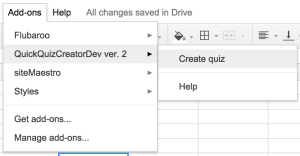 Open a Google Sheet
If you don’t want to deal with beta, try out the template Sheet that John started this with.
Here is a quick video of the steps above.
There may be any variety of reasons you may need to copy the text from a image file or PDF. Google Docs can help you with that process if you don’t have access to an application like Adobe Acrobat Pro or an OCR conversion application. Here is how.
FIRST – Upload the image file or PDF to your Google Drive account and select it.
Here I am using a PDF shared by Richard Byrne on his blog Free Technoogy for Teachers.
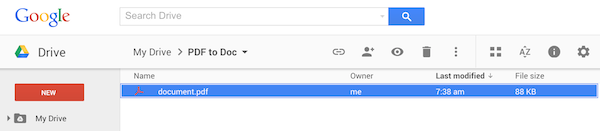
NEXT – With the file selected in your Google Drive (not when it is opened in preview mode), click on the the three vertical dots that represent the “More Actions” menu. Choose “Open with” and select “Google Docs.”
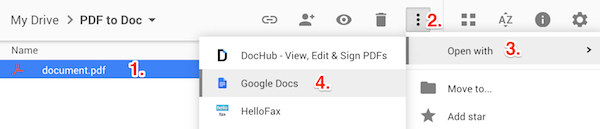
FINALLY – Google Drive’s optical character recognition (OCR) jumps into action. Google Drive scans the file and uses its magic algorithms to convert the file into a Google Document. It’s not perfect but it can certainly help in a pinch.
Note: Video has no sound
The conversion will be most accurate if:
There are limitations. The file size cannot be over 2 MB. If you are working with a PDF, only the first 10 pages are scanned and converted.
Some of the formatting may carry over into the converted text but don’t be surprised if you need to do some clean-up. Still, this process can be a big time-saver when the clock is ticking.
I’ve been busy gathering sponsors for our upcoming EdCamp Memphis and am pleased to list Picmonic among them. Before yesterday, didn’t about them and that’s a shame. Another sponsor, BirdBrain Science, shared a link with me to the article 7 EdTech Startups Revolutionizing STEM. Both Picmonic and BirdBrain Science are listed in the article and both deserve a moment of your time.
Picmonic is a web-based application that delivers audiovisual mnemonics designed to improve memory retention.
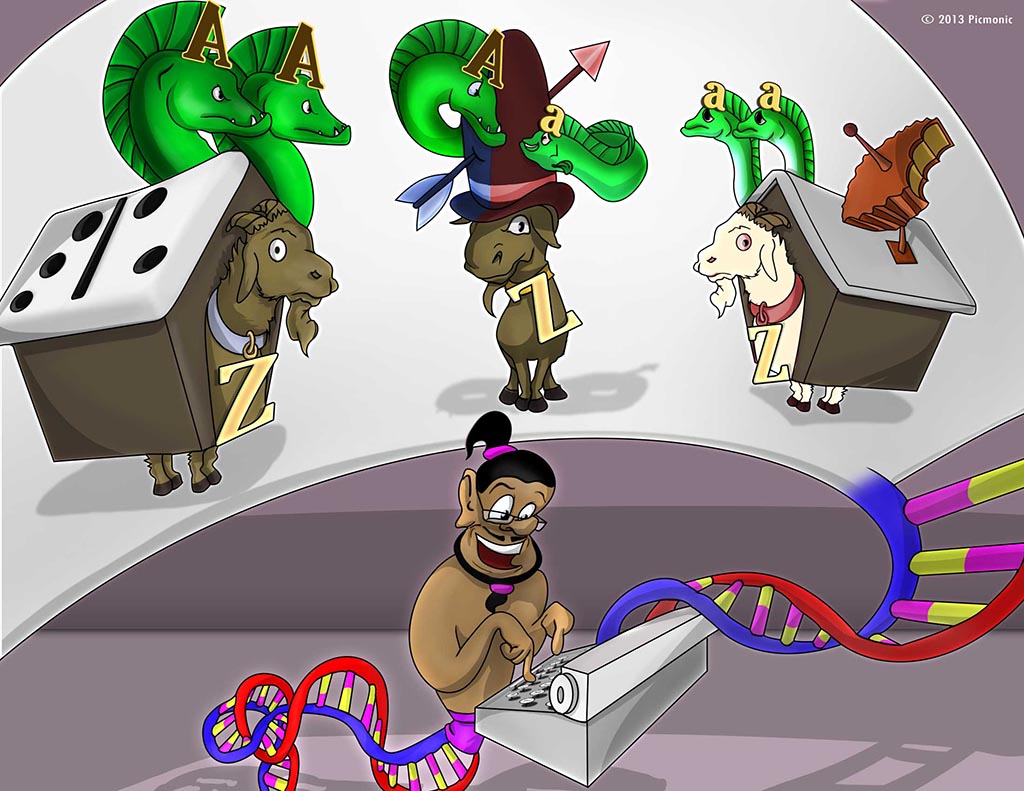
This technique could certainly be used by teachers of other subjects. I can envision teachers utilizing blended learning creating their own mnemonic illustrations (maybe combined with the concept of sketchnoting) to help students with memory and making deeper connections with what they are learning.

When I first began to grow my digital PLN, Twitter was my go-to space. It remains the cornerstone of my PLN but, over the years, I’ve expanded to include many more avenues. Google+ conversations, especially those in various Google+ Communities, are an ever-growing element of my learning network.
If you have a Google account but haven’t started using Google+ yet, this blog post by Alice Keeler about a presentation by @davidtedu can help you get started. The Google+ Help website also provides excellent support.
Communities in Google+ provide an area for people with similar interests to discuss various topics. You as a user also has control over how much of those posts appear in your Google+ stream. I follow a large number of Communities because I am an info junkie but I only have a core group of these actually appear in my stream. When I want to get my fix of the others, I visit the pages for those Communities and soak up the eduConversations.
I help moderate a few Google+ Communities:
Here are some other communities of interest you may want to check out. There are many, many more out there that I follow but these can help get you going.
Google and Google Apps Related –
Education and EdTech Related –
Google+ Help regarding finding more communities.
What are some of the Google+ Communities you find most helpful and why? Share in the comments for the post.

The Zooniverse is a collection of web-based citizen science projects that use the efforts of volunteers to help researchers deal with the flood of data that confronts them. Anyone can participate and teachers can certainly use this with their students. Their collection of activities gives a real-world context for showing students how they can contribute to the world of science and society in general.
Projects are divided into categories: space, climate, humanities, nature, biology, and physics.

How can your students help Penguin Watch? Students simply look at pictures and click on areas to identify adult penguins, baby penguins, or penguin eggs. The data is then used by the project to improve understanding of these species. The notations students make on the images will also aid in “training” a computer to automatically recognize penguin individuals.

Some of the other projects by Zooniverse are:
Projects also have chats available with the scientists so you and your students can ask questions of the experts themselves.
Possible extensions:
Whether you have students do these individually or you do as a whole-class activity with an interactive whiteboard, this activity has endless connections to expand your students’ knowledge of the world around them.
Hear an interview with one of the scientists on NPR: Researchers Enlist Internet Users To Help Monitor Penguins
Part of my personal action plan for 2015 includes listening to more podcasts, especially those hosted by influential educators in my PLN. Today I chose to listen to “Getting Over the Barriers to Creativity and Innovation in the Classroom” (#EdChat Radio, November 20, 2014).
Take 12 minutes to listen to the podcast and then take some action in your classroom.
Try this:
Now what?
Focus your initial efforts on the things that are easier to change. This will give you an instant feeling of success and progress toward your ultimate goal. However, don’t forget about the items in the other two categories. Revisit them from time to time and see how they have changed. The difficult items may be easier after you implement some of the easy changes.
Share your list with others. It will help you stay motivated to make the changes you can and may even inspire them to do the same.
Document your progress by reflecting on your blog, in a journal, in your PLN, or here! Post your priorities in the comments below so we can all support you in your efforts to overcome the obstacles to creativity and innovation in your classroom.
I just listened to an episode of EdTech Chat on BAM! Radio from 10-7-13 titled “Finding a Framework for Transitioning to Digital Learning.” The topic remains timely in the field of education and in my world in particular.
The 14 minute show is packed with wonderful tidbits and quotes I wanted to share. Taking place in the discussion are Pam Moran (@pamoran), Mary Ann Wolf (@maryannwolfed), Glenn Kleiman (@gkleiman2), and Tom Murray (@thomascmurray).
I won’t regurgitate the transcript but here are a few of the questions posed and some gems that hit home.
How do we go about transforming the traditional classroom so that we can prepare students for their future and not our past?
How can school districts implement professional development so that we can get our teachers to the point where they need to be?
What does professional development need to look like to transform the teachers’s instruction to ultimately help kids?
I particularly like the discussion about the responsibility of the school district and school in the process. Partially related to the providing of the training but especially when it comes to making the expectations clear. Those expectations need to go beyond boxes on an evaluation rubric.
Mary Ann brought up the “importance of both formal and informal professional learning opportunities for educators.” Teachers in her district are given structured pieces via a MOOC but are also given the ability to be self-directed. It’s important to meet teachers where THEY are and give them access to professional learning that they can get the competencies that they need. “It’s really important that we make sure that teachers know about and have access to professional learning that really is personalized for them too.” Pam Moran added that MOOCs, PLCs, PLNs, and flipped staff meetings give teachers lots of opportunities to see where they are heading so they know what THEY need to learn to meet expectations.
“The one-size fits all is no longer working. Doesn’t work for kids and it certainly doesn’t work for teachers as well. Districts spend a lot of time preaching differentiation for kids but then often turn around and do the exact opposite for their own staff members.” – Glenn Kleiman
Teachers are learners just like students are learners and they’re going to learn differently so how do we help them design their own roadmaps?
How can a digital classroom transform teaching and learning? Glenn shared that “the tools we now have make it so much more feasible to personalize learning.” Pam stressed that we need to step away from “the Gutenberg Model of ‘write it, print it, read it, recall it, listen to it’ to a ‘search, connect, communicate, make’ post-Gutenberg model.

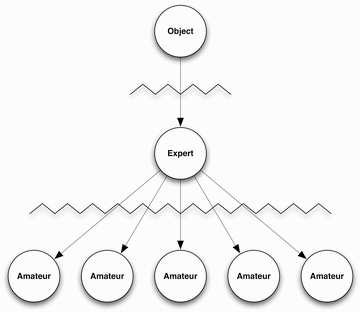
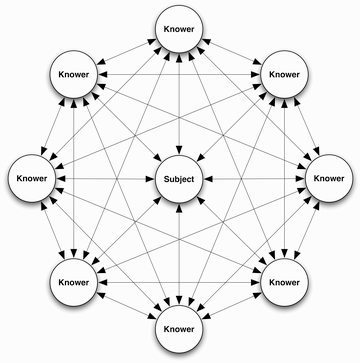
After searching a little bit about concepts related to Pam’s statement, I came across these two diagrams of the relationship of teacher and learner and subject. (source) They are derived from “The courage to teach : exploring the inner landscape of a teacher’s life” by Parker J. Palmer.
The traditional paradigm of “sage on the stage” is one with which we are all too familiar:
The environment we must embrace (and one that is so much more dynamic and inspiring) looks more like this:
I followed that reading by listening to the EdTech Chat podcast “Using Technology to Personalize Professional Development,” the episode with my fellow GTA Shaelynn Farnsworth (@shfarnsworth). Shaelynn, Tom Murray, and Sharon Plante have a refreshing conversation that I think captures concepts related to the needed paradigm shift for professional development. We have to move toward personalized learning for teachers that is not related to required hours of training but focuses on the outcome, the learning. Here are two great quotes from Tom:
“I don’t care what you attended. I care what you learned.”
“It’s really interesting how we traditionally herd teachers like cattle into large group rooms, we talk at them for two hours, and then we call it ‘professional development.'”
In addition to discussing various technology tools (Twitter, Edmodo, Google+), I liked the information about the EdCamp model (bottom-up) for PD as opposed to the traditional top-down, one-size-fits-all approach. A big part of that shift involves the district taking the planning for PD out of the hands of a few key people and move it to a shared learning experience. Shaelynn brings up the work of Dan Lortie and the term “apprenticeship of observation.” This refers to the tendency of teachers to revert back to how they were taught when the training they have received is lacking in some way. So, if district and school leaders want teachers to educate our students in a more differentiated way, those leaders need to model that in the professional development provided.
The conversation closed with talking about how to make this happen fed right into my philosophy of PD. Find the opportunities for yourself and don’t wait for your school or district to provide them for you.
“Teachers are passionate and they want to improve their own practice for student learning, they want to reflect upon it, and they want to share it and grow. – Shaelynn Farnsworth
“We need a culture shift in schools, we need to develop systemic approaches that are modeled by our administrators, that are not top-down, which cultivate teacher leadership.” – Tom Murray
As I continue to research my proposed dissertation topic (the impact of informal professional learning on counteracting teacher burnout) and work on my GTA innovation project (giving teachers and parents tangible, bite-sized steps to take in order to give children more ownership of their learning), I will be exploring these concepts in much more detail and will share my reflections here.